|
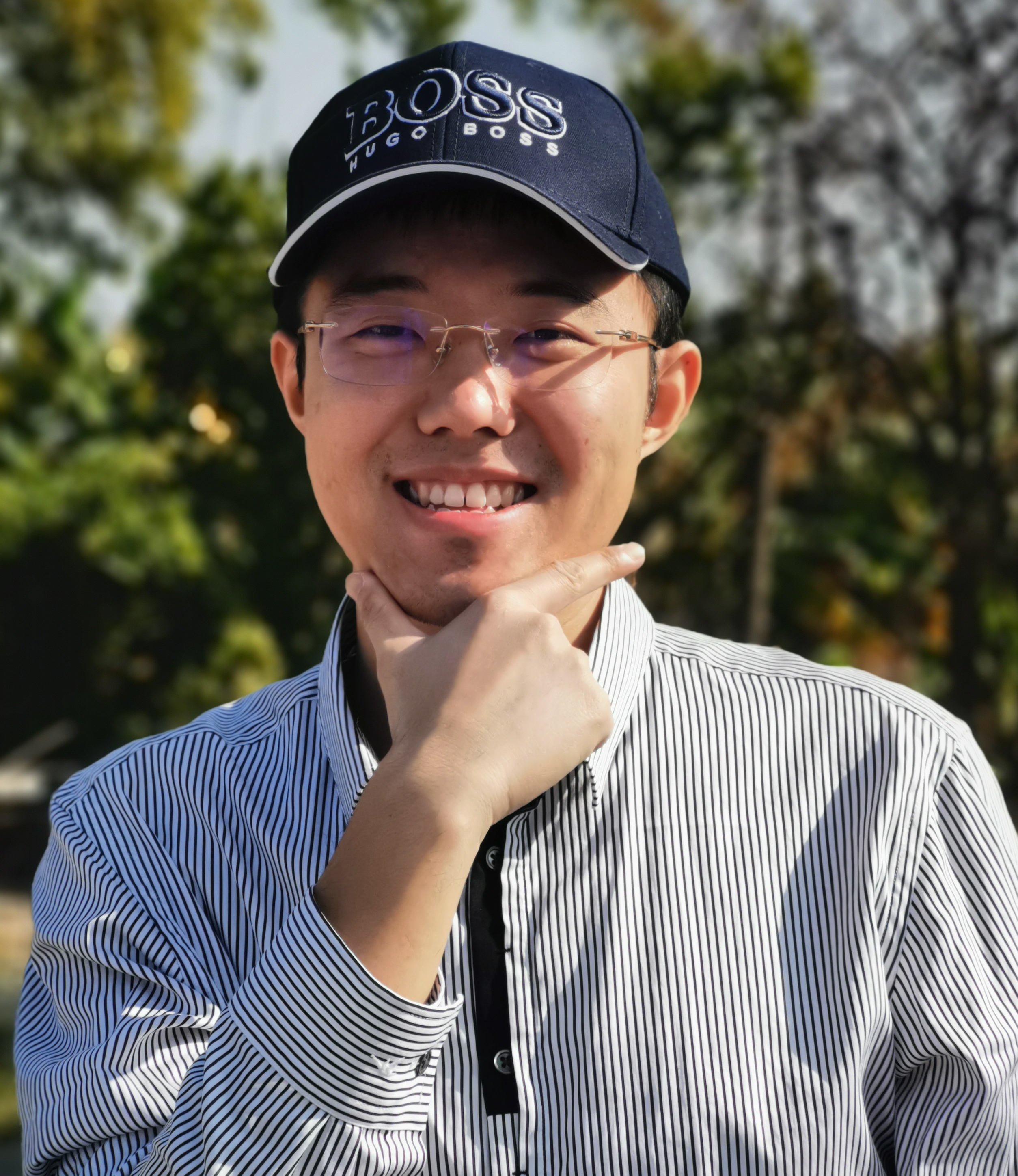
Lanqing Li (李蓝青)
I’m a final-year PhD in computer science and engineering at The Chinese University of Hong Kong with 7+ years of experience in industrial research labs, undertaking principal investigator at Zhejiang Lab (2023-2026), and senior research scientist (T10)
at Tencent AI Lab (2019-2023) working on machine learning and its applications in drug discovery and autonomous control. Prior to my endeavor in AI research, I received training in physics from MIT and UChicago, and was also a gold medalist of the International Physics
Olympiad (IPHO 2011), winning the Prize of Best Score in Theory.
My research covers core machine learning and AI for Science, with a focus on applications in biomedical domains like drug discovery and biomaterial design. The overarching goal of my work is to establish principled methods to develop trustworthy AI systems
with translational impact.
Email /
CV /
Bio /
Google Scholar /
LinkedIn /
Github
|
|
|
Research
I'm interested in robust machine learning, AI-aided drug discovery (AIDD), reinforcement learning (RL), and AI for science.
In particular, I work on the understanding and development of machine learning algorithms that are robust to distribution shift, imbalanced/offline data, etc.,
to better facilitate the computational design and synthesis of drugs. For those keen visitors, please find my related publications below.
Hiring! We are looking for full-time researchers, engineers, post docs and highly-motivated Ph.D. students and interns to join our team. The openings cover the following exciting areas:
- Computational Drug Design & Synthesis, e.g., De Novo Drug/Protein Design, Generative Models, Retrosynthesis
- Robust Machine Learning, e.g., OOD/Imbalanced/Continual Learning
- Reinforcement Learning, e.g., Offline/Meta RL, RL for Molecular Design, Physics-informed RL
Feel free to shot an email if you are interested.
|
News
-
2024/09/25: Our work on Offline Meta-RL (UNICORN) accepted to NeurIPS 2024 as a spotlight paper.
-
2024/08/23: Application approved for Young Scientists Fund of the National Natural Science Foundation of China (Grant No. 62406295).
-
2023/09/27: Our work on protein inverse folding and protein large language model at Zhejiang Lab are reported by CCTV News,
check out 01:41:00-01:46:00 in this recording!
-
2023/09/26: Our CVPR paper CC-SAM
is selected as a highlight by CCF多媒体专委会.
-
2023/06/18: 2 CVPR papers, CC-SAM
on deep long-tailed recognition, and MIT on uncertainty
calibration are published.
-
2023/02/28: 2/2 papers accepted to CVPR 2023.
-
2022/11/20: 3/3 papers, ImGCL, DrugOOD and
MEGAE, are accepted to AAAI 2023.
-
2022/09/19: Our AIDD benchmark for imbalanced learning algorithms, ImDrug, now appears on arXiv.
-
2022/09/15: 1 paper accepted to NeurIPS 2022.
- 2022/07/11: 1 paper VPQ appears at ACM SIGIR 2022.
- 2022/05/15: 1 paper LA-GNN accepted to ICML 2022.
- 2022/04/30: I will co-mentors this year‘s Tencent AI Lab Rhino-Bird Focused Research Program,
with a focus on 3D de novo drug design and drug-target interaction.
- 2022/03/02: I will co-mentor this year's Tencent AI Lab Rhino-Bird Elite Training Program,
with a focus on deep graph learning and its applications in OOD and long-tailed settings.
- 2022/01/24: Our AIDD benchmark for out-of-distribution algorithms, DrugOOD, now appears on
arXiv.
|
|
Selected Publications (*: co-first author, †: corresponding author, ‡: my group members or interns)
|
AI for Drug Discovery
ImGCL: Revisiting Graph Contrastive Learning on Imbalanced Node Classification
Liang Zeng‡,
Lanqing Li†,
Ziqi Gao‡,
Peilin Zhao ,
Jian Li†
AAAI, 2023
paper
/
arXiv
/
poster
/
code
We introduce an important yet under-explored problem, namely graph contrastive learning on imbalanced node classification. We propose a novel ImGCL self-training framework as an effective solution, which utilizes the node centrality based progressively balanced sampling methods to obtain balanced labels, with theoretical insight for its convergence.
|
Handling Missing Data via Max-Entropy Regularized Graph Autoencoder
Ziqi Gao‡,
Yifan Niu,
Jiashun Cheng,
Jianheng Tang,
Tingyang Xu ,
Peilin Zhao ,
Lanqing Li†,
Fugee Tsung,
Jia Li†,
AAAI, 2023
paper
/
poster
/
code
We present a regularized graph autoencoder for graph attribute imputation, named MEGAE, which aims at mitigating
spectral concentration problem by maximizing the graph spectral entropy. Notably, we first present the method for
estimating graph spectral entropy without the eigen-decomposition of Laplacian matrix and provide the theoretical
upper error bound.
|
Hierarchical Graph Learning for Protein–Protein Interaction
Ziqi Gao‡,
Yifan Niu,
Chenran Jiang,
Jiawen Zhang,
Xiaosen Jiang,
Lanqing Li,
Peilin Zhao ,
Huanming Yang,
Yong Huang,
Jia Li,
Nature Communications 14.1 (2023): 1093. (selected to Editors’ Highlight collection)
paper
/
poster
/
code
We present a double-viewed hierarchical graph learning model, HIGH-PPI, to predict PPIs and extrapolate the molecular details involved.
In this model, we create a hierarchical graph, in which a node in the PPI network (top outside-of-protein view) is a protein graph (bottom
inside-of-protein view). In the bottom view, a group of chemically relevant descriptors, instead of the protein sequences, are used to better
capture the structure-function relationship of the protein.
|
|
Robust Machine Learning
Class-Conditional Sharpness-Aware Minimization for Deep Long-Tailed Recognition
Zhipeng Zhou‡*,
Lanqing Li*,
Peilin Zhao,
Pheng-Ann Heng,
Wei Gong,
CVPR, 2023
paper
/
code
Based on PAC-Bayesian framework, we develop a novel sharpness-aware robust optimization scheme to improve the generalization of deep long-tailed learning methods.
|
On the Pitfall of Mixup for Uncertainty Calibration
Deng-Bao Wang‡,
Lanqing Li†,
Peilin Zhao,
Pheng-Ann Heng,
Min-Ling Zhang†,
CVPR, 2023
paper
/
code
We interrogate the general perception that mixup training improves uncertainty calibration. Through systematic empirical studies,
we conclude that the answer is quite the opposite when post-hoc calibration is considered. To circumvent this "pitfall", we propose a
general strategy named mixup inference in training (MIT), which adopts a simple decoupling principle for recovering the outputs of raw samples
at the end of forward network pass.
|
|
Reinforcement Learning
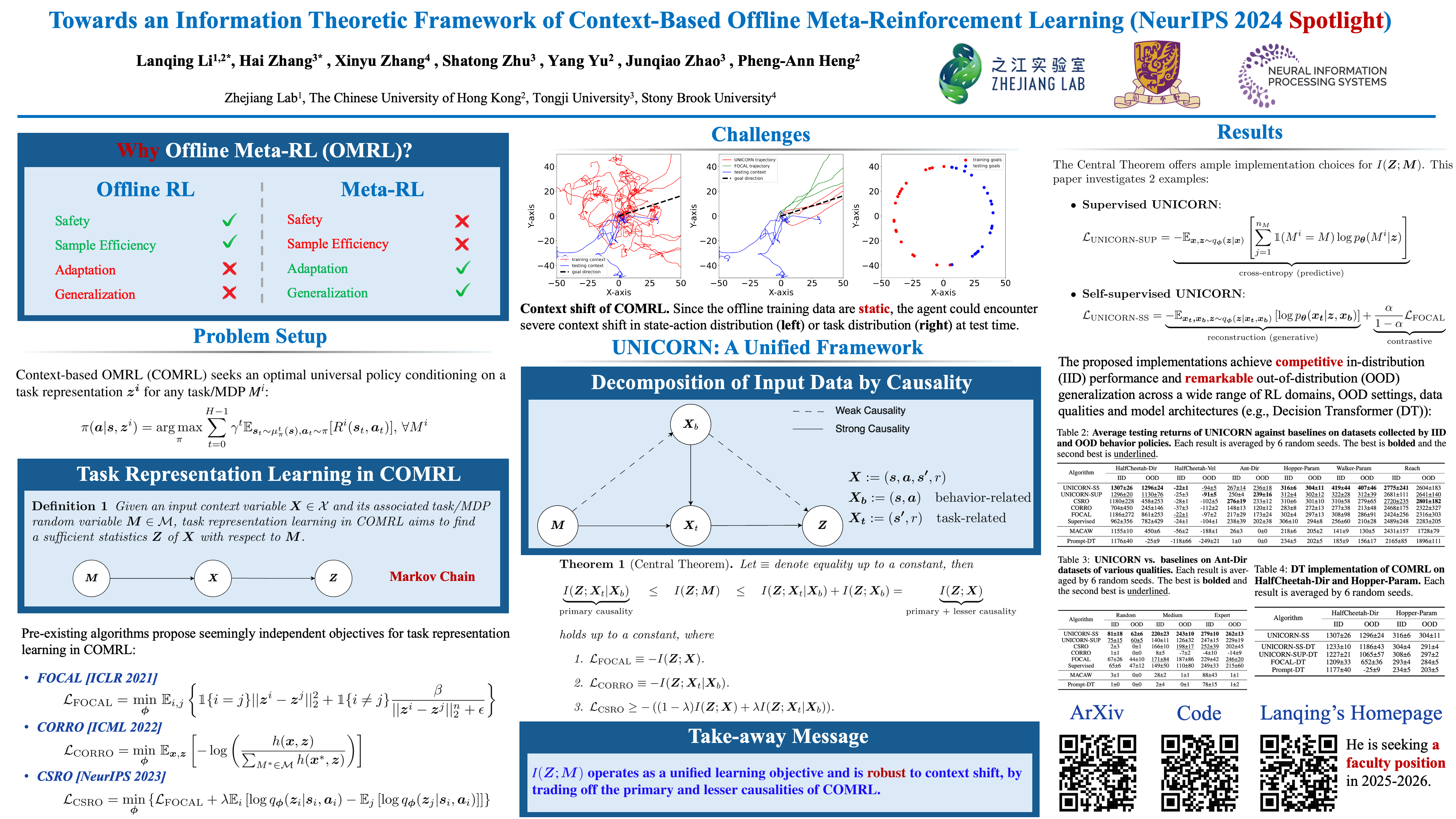
Towards an Information Theoretic Framework of Context-Based Offline Meta-Reinforcement Learning
Lanqing Li*,
Hai Zhang ‡*,
Xinyu Zhang ,
Shatong Zhu ,
Yang Yu ,
Junqiao Zhao ,
Pheng-Ann Heng
NeurIPS Spotlight , 2024
paper
/
poster
/
code
We propose a novel information theoretic framework of the context-based offline meta-RL paradigm,
which unifies several mainstream methods and leads to two robust algorithm implementations.
Our framework provides a principled roadmap to novel COMRL algorithms.
|
Value Penalized Q-Learning for Recommender Systems
Chengqian Gao‡,
Ke Xu,
Kuangqi Zhou,
Lanqing Li,
Xueqian Wang ,
Bo Yuan ,
Peilin Zhao
SIGIR, 2022
paper
/
poster
/
code
We propose Value Penalized Q-learning (VPQ), a novel uncertainty-based offline RL algorithm that penalizes
the unstable Q-values in the regression target using uncertainty-aware weights, achieving the conservative Q-function without the
need of estimating the behavior policy.
|
iGrow: A Smart Agriculture Solution to Autonomous Greenhouse Control
Xiaoyan Cao‡,
Yao Yao,
Lanqing Li,
Wanpeng Zhang ,
Zhicheng An‡ ,
Zhong Zhang,
Shihui Guo ,
Li Xiao,
Xiaoyu Cao ,
Dijun Luo
AAAI, 2022
paper
/
arXiv
/
poster
/
code
A pioneering smart agriculture solution to autonomous greenhouse control based on reinforcement learning, genetic algorithms and black-box simulator.
|
FOCAL: Efficient Fully-Offline Meta-Reinforcement Learning via Distance Metric Learning and Behavior Regularization
Lanqing Li†,
Rui Yang‡,
Dijun Luo†
ICLR, 2021
paper
/ poster
/ presentation
/ arXiv
/ code
The first end-to-end model-free offline meta-RL algorithm, in pursuit of more practical RL.
|
A Simulator-based Planning Framework for Optimizing Autonomous Greenhouse Control Strategy
Zhicheng An‡ ,
Xiaoyan Cao‡,
Yao Yao,
Wanpeng Zhang ,
Lanqing Li,
Yue Wang,
Shihui Guo ,
Dijun Luo
Proceedings of the Thirty-First International Conference on Automated Planning and Scheduling (ICAPS), 2021
paper
/
arXiv
/
poster
/
code
We explore and examine the feasibility of black-box optimization based on a data-driven simulator for optimal control of autonomous greenhouses.
|
|
|
Scientific Community Activities
Invited Talks and Seminars
- Intelligent Drug Discovery Platform and Its Applications, presented at the "Computation + Biology" Youth Academic Research Symposium, Zhejiang lab. (09/2023)
- Guest lecture on reinforcement learning applications. The Chinese University of Hong Kong, Shenzhen. (02/2023) Slides
Academic Services
- Reviewer, ICLR 2024
- Reviewer, CVPR 2023
- Reviewer, ICML 2022, 2023
- Reviewer, NeurIPS 2022, 2023
- Reviewer, IJCAI 2021, 2022
- Reviewer, TPAMI
|
|